SUARA BAPTIS PAPUA

Dukung Aksi Perdamaian Atas Kekerasan di Papua Barat.
Jika Anda Peduli atas kemanusiaan Kaum tertindas di Papua barat Mohon Suport di sini:

Please donate to the Free West Papua Campaign U.K.
Kontribusi anda akan kami melihat ada perubahan terhadap cita-cita rakyat papua barat demi kebebasan dan kemerdekaannya.
Peace ( by Voice of Baptist Papua)

Apa Solusi Atas Konflik Papua?

Scoop Voice Baptist

About Me

My Photo
Papua, Papua barat/Indonesia, Indonesia
Persekutuan Gereja-Gereja Baptis Papua tidak akan pernah memilih diam ketika umat ditintas dan akan terus bersuara sampai keadilan benar-benar terjadi di tanah papua

Voice of Baptist Papua

Asian Human Rights Commission

Welcome to Suara Baptis Papua Online

SB - PAPUA-News

© Copyright 2011 suara baptis papua. Powered by Blogger.

Latest Post

Showing posts with label indigenous populations. Show all posts

Jared Diamond – Apology Demanded From West Papua Leaders

Written By Voice Of Baptist Papua on February 4, 2013 | 5:35 AM


Jared Diamond's book has come under attack for portraying tribal people as warlike and 'living in the past'. © Survival

WEST PAPUA, THUNDER BAY - Jared Diamond must apologize for controversial statements about West Papua tribes. West Papau leaders say Jared Diamond, a controversial author must apologize for describing them in his new book as warlike, and strengthening the idea that indigenous people are ‘backwards’.

The West Papuan leaders attack Diamond’s central arguments that ’most small-scale societies (…) become trapped in cycles of violence and warfare’ and that ‘New Guineans appreciated the benefits of the state-guaranteed peace that they had been unable to achieve for themselves without state government.’

Jared Diamond Insults West Papua People

Survival International in a release states, "Mr Diamond makes no mention of the brutality and oppression suffered by the people of West Papua at the hands of the Indonesian occupation since 1963, which has led to the killing of at least 100,000 Papuan tribal people at the hands of the Indonesian military.

"Benny Wenda, a Papuan tribal leader, said to Survival, ‘What he (Jared Diamond) has written about my people is misleading (…) he is not writing about what the Indonesian military are doing (…) I saw my people being murdered by Indonesian soldiers and my own Auntie was raped in front of my eyes. Indonesia told the world that this was ’tribal war’ – they tried to pretend that it was us that was violent and not them – this book is doing the same. He should apologize.’"

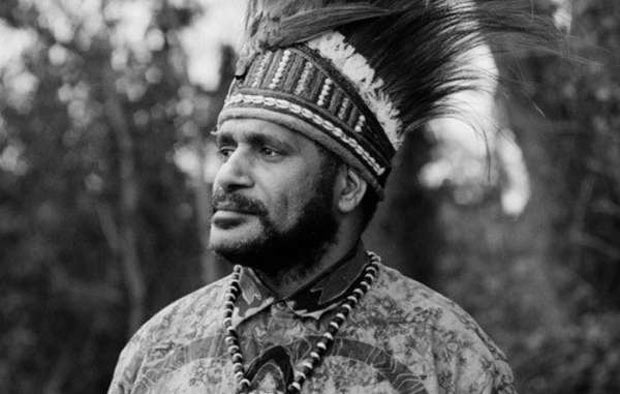
Benny Wenda, a Papuan tribal leader, says what Jared Diamond is writing about his people is 'misleading'. © Survival
Benny Wenda, a Papuan tribal leader, says what Jared Diamond is writing about his people is misleading'. © Survival

Dani victims from the Indonesian atrocities

Markus Haluk, a senior member of the Papuan Customary Council, added, ‘The total of Dani victims from the Indonesian atrocities over the 50 year period is far greater than those from tribal war of the Dani people over hundreds of thousands of years.’

Matius Murib, Director of the Baptist Voice of Papua, condemned Diamond’s assertion that tribal peoples live in a ‘world until yesterday’. He said, ‘This book spreads prejudices about Papuan people (…) that indigenous Papuans still display a way of life from hundreds of years ago. This is not true and strengthens the idea that indigenous people are ’backwards’, ‘live in the past’ or are ‘stone age.’
Reverend Socratez Yoman, Head of the West Papuan Baptist Church, has also demanded an apology from Mr Diamond to the Papuan people.

Dominikus Surabut, currently jailed for treason for peacefully declaring West Papuan independence, described the relationship of indigenous West Papuans and the Indonesian state as political apartheid. In a statement smuggled out of his jail cell, he said, ‘This is the very nature and character of colonial occupation of indigenous peoples, where they are treated as second class citizens whose oppression is justified by painting them as backwards, archaic, warring tribes – just as suggested by Jared Diamond in his book about tribal people.’

With files from Survival International

INDONESIA: Tatchell arrested at Indonesian President protest

Written By Voice Of Baptist Papua on November 2, 2012 | 1:21 AM

West Papuan flag unfurled - Arrest for breach of the peace
President accused: War crimes in West Papua & East Timor


London - 1 November 2012 (Published Asia Human Rights Commission)

The State Visit to the UK of Indonesian President Susilo Bambang Yudhoyono has been beset by protests against his government’s human rights abuses in West Papua, Aceh and the Moluccas.

On Wednesday police arrested human rights campaigner Peter Tatchell when he unfurled a West Papuan flag as the Indonesian President’s limousine departed Westminster Abbey in central London.

"I went to where the President's motorcade was passing and tried to hold up a West Papuan flag. Unidentified men in plainclothes wrestled me to the ground. I was then arrested by Metropolitan Police officers, who claimed they were acting at the request of the President's entourage. The officers applied unnecessary, excessive force, given that I was no threat and was not resisting arrest," said Mr Tatchell, who is Director of London-based the human rights organisation, the Peter Tatchell Foundation.

He was one of nearly 100 protesters who had gathered to protest at human rights abuses by the Indonesian regime.

Still photos and video footage are available from Claudio von Planta: 07785 330 616
https://vimeo.com/52566880


"President Susilo Bambang Yudhoyono should have been arrested on charges of war crimes and crimes against humanity under British and international law. I settled for displaying the West Papuan flag as the President's motorcade passed by. I was stunned to be chased and arrested for a peaceful, lawful protest.

"The Indonesian President stands accused of crimes against humanity in East Timor and West Papua, involving the deaths of thousands of people.

"It is appalling that the Royal Family and the Prime Minister are hosting a man who is implicated in mass murder. Well in excess of 100,000 West Papuan civilians have been killed by the Indonesian army.

Watch this film of the Indonesian security services opening fire on peaceful, unarmed pro-democracy protesters in West Papua on 23 October 2012:
http://youtu.be/7Py9Ghj-8Xg

"Under Indonesian rule, West Papuans are denied basic human rights, including freedom of expression. Two Papuan men, Yusak Pakage and Filep Karma, have been jailed for 10 and 15 years respectively for merely raising the West Papuan flag. Foreign media and human rights groups are denied access to the region by the Indonesian Government.

"The Indonesians annexed West Papua in the 1960s. The West Papuan people never agreed to be a part of Indonesia. Jakarta maintains its rule by military force. It refuses to allow the people of West Papua the right to self-determination, in flagrant defiance of the United Nations Charter.

"A long, slow genocide is being perpetrated in West Papua.

"I was arrested for a peaceful, lawful protest, which involved nothing more sinister than holding a flag. I was deemed to have breached the peace. I was also threatened with further breach of the peace charges for "shouting loudly" and for what one police officer described as "pointing your finger at me in a way that I find intimidating."

"A police officer intimidated by a pointed finger? Bizarre. Are police officers nowadays really such ultra-sensitive souls? Heavens help us if they have to deal with hardened criminals with weapons.

"I was put in rigid handcuffs that were twisted by the police, which pinched the nerves in my wrist; causing agonising pain. It seemed like this was deliberate. I am still in pain hours later but what was done to me is nothing by comparison to the daily brutalities inflicted on the heroic people of West Papua by the Indonesian army of occupation.

"I am saddened that some police officers apparently have no respect for freedom of expression and the right to peaceful protest.

"I was detained unlawfully and deprived of my liberty for two hours. After being taken to Charring Cross police station, I was eventually released without charge. Clearly, the police knew they had over-stepped the mark and that the charges against me were baseless," he said.

 -------------------------------------------------------------------------------------------------
The Indonesian President's State Visit to the UK is from 31 October to 2 November.
Document Type :
Forwarded Statement
Document ID :
AHRC-FST-049-2012
Countries :

Indonesia indigenous peoples: We exist!

Written By Voice Of Baptist Papua on October 30, 2012 | 12:28 AM

The government of Indonesia this month responded to UN recommendations to recognize the rights of its indigenous peoples by claiming that none live in the country. In a response to the UN's Universal Periodic Review, a four–year human rights check-up for all countries, Indonesia said, "The Government of Indonesia supports the promotion and protection of indigenous people worldwide… Indonesia, however, does not recognize the application of the indigenous peoples concept… in the country."

The UN’s report recommended that Indonesia should consider ratifying International Labor Organization Convention 169, the only international standard for indigenous and tribal peoples. It also recommended that Indonesia should secure the rights of its indigenous peoples, especially to their traditional lands, territories and resources.

UK-based advocacy group Survival International believes that "Indonesia treats its indigenous and tribal people worse than any other country in the world," especially citing the case of West Papua, where killings, torture and rape of tribal people have been repeatedly documented. The figure of 100,000 people killed since 1963 is believed to be a "conservative estimate," according to Survival.

The Indonesian government does recognize exactly 365 distinct ethnic and sub-ethnic groups—but defines them as "komunitas adat terpencil," or "geographically-isolated customary law communities." These number approximately 1.1 million, out of a total population of nearly 250 million. Indonesia is a signatory to the UN Declaration on the Rights of Indigenous Peoples, but the government's official position is that concept of indigenous peoples is not applicable to the country, as almost all Indonesians (with the exception of the ethnic Chinese) are indigenous.

The national indigenous peoples' organization, Aliansi Masyarakat Adat Nusantara (AMAN), uses the term masyarakat adat to refer to indigenous peoples (meaning, more or less, "traditional communities"). By AMAN's estimate, Indonesia is home approximately 50 million indigenous and tribal people. (Intercontinental Cry, Oct. 3; Survival International, Oct. 1; International Working Group for Indigenous Affairs)

Source: http://ww4report.com/node/11651

U.N. Report Chastises U.S. for Status of Native Population

Written By Voice Of Baptist Papua on September 23, 2012 | 11:35 PM

By Carey L. Biron - Inter Press Service
 
UN
WASHINGTON, Sep 20 2012 (IPS) - A top United Nations official has presented the first ever international investigation into the situation of indigenous peoples in the United States, urging the adoption of new policies and mechanisms to “address persistent deep-seeded problems related to historical wrongs, failed policies of the past and continuing systemic barriers”.
Based on research in the United States this past spring, James Anaya, the U.N.’s special rapporteur on the rights of indigenous peoples, presented his final report to the U.N. Human Rights Council (UNHRC) in Geneva on Tuesday. The process marks the first time that the United States has allowed an external body to formally investigate and comment on the situation of its indigenous communities, a notably sensitive issue.
Speaking before the council, Anaya stated that indigenous communities in the United States (also referred to as American Indians) continue to “face significant challenges that are related to widespread historical wrongs, including broken treaties and acts of oppression, and misguided government policies, that today manifest themselves in various indicators of disadvantage and impediments to the exercise of their individual and collective rights.”
The U.S. mission to the UNHRC has offered a formal response to the concerns raised, highlighting several new and recent government initiatives and policy changes.
These include a three-percent increase – to 19.4 billion dollars – in President Barack Obama’s budget request for 2013 in funding earmarked for indigenous communities, as well as changes under the country’s newly expanded health insurance legislation that would include a 29-percent increase to the budget of the Indian Health Service over 2009 figures.
(By deadline, the U.S. Bureau of Indian Affairs did not respond to requests for comment on the report.)
Yet the special rapporteur cautioned that “existing federal programmes need to be improved upon and their execution made more effective.”
Indeed, the 310 tribal-overseen “reservations” in the United States, on which about half of the 4.5 million-strong Native American population lives today, are sites of some of the country’s most grinding poverty. Some reservations see 66-percent unemployment figures, while rates of alcoholism are five times that of the rest of the U.S. population.
According to the most recent U.S. census statistics, a quarter of all Native Americans live in poverty and nearly a third lack health insurance, suffering from several health problems at far higher rates than the rest of the country. According to 2003 data, fewer than half of Native American youths were expected to graduate from high school.
Such marginalisation has led to rights abuses that advocates say have yet to be addressed by either the U.S. government – or, some suggest, by Anaya’s report.
“Although the special rapporteur failed to recognise the growing problem of human and civil rights violations among the indigenous people of the United States, I am not surprised,” John Gomez, with the American Indian Rights and Resource Organization, told IPS. “To acknowledge that the problem exists, and that the United States has taken no action to protect the rights of the individuals being persecuted, would expose the hypocrisy of the U.S. government and the current administration.”
Gomez says that U.S. policies in addressing rights violations abroad versus within its own borders are contradictory. “The indigenous people of the United States,” he says, “deserve the same type of action taken by the United States government to deter or quash cruel and unusual punishment … on foreign soil.”
Centrality of land
Last week marked the fifth anniversary of the U.N.’s adoption of the Declaration on the Rights of Indigenous Peoples, which recognises a spectrum of indigenous peoples’ rights to self-determination and governments’ concurrent responsibilities. When it was passed, in mid-September 2007, the United States was one of only four countries, out of 143, to refuse to vote for its adoption.
In 2010, however, President Obama announced that the U.S. would reverse its position. At the time, the president stated that “few have been more marginalised and ignored by Washington for as long as Native Americans … While we cannot erase the scourges or broken promises of our past, we will move ahead together in writing a new, brighter chapter in our joint history.”
Anaya’s report underscores the continued relevance of the declaration, and calls on the United States to use it as “an important impetus and guide for improving on existing measures”.
Further, the special rapporteur appears to take some issue with President Obama’s suggestion that little can be done to address the past. In particular, he calls on the U.S. government to take a new look at how it deals with the issue of traditional lands.
In May, at the end of his research trip to the United States, Anaya create a brief public furore by calling for the U.S. government to hand back traditional lands that now include Mount Rushmore, an iconic national memorial comprised of the faces of four notable U.S. presidents carved out of a massive cliff face.
Anaya revisits the issue in his official report, calling the Black Hills an “emblematic case”. While the federal government has initiated some projects to restore control by indigenous peoples over their traditional lands, “My central recommendation … will be for there to be more of these kind of initiatives,” Anaya said in a short videoreleased last week.
The land issue has been fingered as one of the main reasons behind the U.S. government’s initial reluctance to back the Declaration on the Rights of Indigenous Peoples, which recognises indigenous peoples’ rights to traditional lands and resources and urges states to give indigenous communities “legal recognition and protection to these lands”.
Public’s responsibility
While much of Anaya’s report focuses on U.S. government actions, there has also been a significant cultural marginalisation of indigenous communities within U.S. society as well, a lesser-discussed factor that nonetheless has broad impact.
“Two of the biggest obstacles to change are the stereotypes and misconceptions that exist about history and why things are the way they are today,” Helen Oliff, with National Relief Charities, a group that focuses on poverty among U.S. indigenous communities, told IPS.
“The people are simply looking for a level playing field – they’re not looking for an easy life but for equitable opportunity. Importantly, the report echoes the voice of the American Indian people, and is representative of what we hear and see through our work in Indian country.”
Anaya, too, highlights the need for a broader understanding in the U.S. of the realities, both positive and negative, of its indigenous communities.
“What really is needed is greater awareness by the broader American public of the vibrancy and continuity of these peoples within the American social political fabric, and the contribution that indigenous peoples make,” he says. “The larger public, from what I’m seeing, is by and large ignorant about the presence of indigenous peoples … (and that) they face severe challenges.”
He continues: “With that awareness, people can take actions that are appropriate to their local circumstances.”

Where the Highest Population Growth in the World? In Papua. Indigenous Peoples of Papua are threatened

Written By Voice Of Baptist Papua on August 5, 2012 | 9:39 PM

Papuan (photo jubi)
Jayapura, (8/5)---In 2010, the population of Papua province was 2,833,381 people. 735,629 people (25.96 percent) is scattered in urban areas and 2,097,752 people (74.04 percent) scattered in remote areas.  While in the province of West Papua, the population was 760,422 peoples. 227 763 people (29.95 percent) lives in urban areas and 532,659 people (70.05 percent) lives in the remote areas. The total population throughout the Land of Papua in 2010 was 760,422 + 2,833,381 = 3,593,823 peoples.

Besides indigenous populations, the population in a region is also determined by the migration (outsiders and insiders). The migration process itself is categorized into two categories, Risen Migration and Lifetime Migration.

Is the population in Papua is growing significantly? Especially the Indigenous population that be fathomed starting to become a minority.

In the province of Papua, the migrant population continues to increase every year. Results SP2010 (The Population Cencus year 2010) recorded 125,213 residents or 5.0 percent of the population was Risen Migrant inter districts/cities. The percentage of Risen Migrants into urban areas was 11.5 percent and in the remote areas was 2.7 percent. Number of male migrant workers was greater than female, 70,877 versus 54,336 people. So, the sex ratio of Risen Migrants is 130.These data support the theory : Migrants in urban areas are greater than migrants in remote area and more men who make placement.The largest percentage of migrants in the province of Papua was in Jayapura and the smallest was in the district of Central Mamberamo.

In West Papua province, the situation was not different. Risen Migrant's population continue to increase over time. Results of SP2010 recorded 69,732 people or 10.5 percent of the population was
Risen Migrants who moving between districts/cities in West Papua. The percentage of Risen Migrants in urban areas was 1.4 greater than in the remote areas, respectively by 13.1 and 9.3 per cent.
The number of male migrant workers are also greater than female, 40,348 versus 29,384people. In this province, the largest percentage of migrants was in the district of Sorong and the smallest was
inTambrauw.

While the Lifetime migrants in the Papua province according to the SP2010 recorded 600,709 peoples or 21.2 percent was the Lifetime Migrants of inter-district/city. The percentage of Lifetime migrants in urban area was 1.9 greater than in the remote areas, respectively by 53.2and 10.0 percent. The number of male (337,577) migrant workers more than female (263,132). Largest percentage of Lifetime migrants was in Jayapura and the smallest was in the district of Central Mamberamo.

In the province of West Papua, based on the SP2010 recorded 291,233 peoples, or 38.3 percent was the Lifetime Migrants who move inter-district/city. The percentage of migrants in urban areas was 52.3 percent and in remote areas was 32.3 percent. The number of male Lifetime Migrant workers more than female, is about 160,750 versus 130,483 people. The percentage of largest Lifetime These data from BPS (Central Bureau of Statistic) in these two provinces not able to determine the population of Indigenous and migrant populations. 
But one thing is certain, the growth population in Papua is the highest in Indonesia, even in the world. As was stated by the Head of Central Bureau of Statistics of Papua Province, Djarot Soetanto, "In the last ten years(2000-2010) Population Growth Rate (LPP) in Papua is the highest in Indonesia, could even say the highest inthe world."

The average of LPP of Papua province reached 5.55 percent per year, where the National LPP only 1.49 percent per year. Although BPS Papua could not be sure what is the main reason of the high rate of population growth, but the Head of BPS Papua ensures that one of the important indicators is the high rate of people who come to Papua.(Jubi/Victor Mambor)

Twitt VBPapua

 
Support : Creating Website | Johny Template | Mas Template
Copyright © 2011. SBP-News @VBaptistPapua - All Rights Reserved
Template Created by Creating Website Published by Mas Template
Proudly powered by Blogger