SUARA BAPTIS PAPUA

Dukung Aksi Perdamaian Atas Kekerasan di Papua Barat.
Jika Anda Peduli atas kemanusiaan Kaum tertindas di Papua barat Mohon Suport di sini:

Please donate to the Free West Papua Campaign U.K.
Kontribusi anda akan kami melihat ada perubahan terhadap cita-cita rakyat papua barat demi kebebasan dan kemerdekaannya.
Peace ( by Voice of Baptist Papua)

Apa Solusi Atas Konflik Papua?

Scoop Voice Baptist

About Me

My Photo
Papua, Papua barat/Indonesia, Indonesia
Persekutuan Gereja-Gereja Baptis Papua tidak akan pernah memilih diam ketika umat ditintas dan akan terus bersuara sampai keadilan benar-benar terjadi di tanah papua

Voice of Baptist Papua

Asian Human Rights Commission

Welcome to Suara Baptis Papua Online

SB - PAPUA-News

© Copyright 2011 suara baptis papua. Powered by Blogger.

Latest Post

Showing posts with label diskriminasi. Show all posts

Extremely high infant mortality in West Papua result of discrimination

Written By Voice Of Baptist Papua on November 13, 2012 | 5:08 PM

 Press release - 
by, Stella Peters (Human Rights Advisor Foundation for Sustainable Development in Papua Barat)

Extremely high infant mortality in West Papua result of discrimination

Amsterdam, 12 November 2012 ? New research on the position of the native population of West Papua reveals that systematic discrimination of Papuans in Indonesian society has resulted in extremely high child mortality. The differences between Papuans and non-Papuans on the Indonesian island are devastating; whereas the rural Papuans have an infant mortality rate of 18,4% non-Papuans have a rate of 3,6%. These statistics indicate a society where Papuans are structurally disadvantaged and discriminated against. As a result of years of Indonesian transmigration politics 50% of the population of West Papua consists of non-Papuans. Interviews held with both population groups confirm that discrimination is deeply rooted into society. Decades of the harrowing Indonesian regime has reduced Papuans to being second-class citizens in their own land.

"The way they treat us, it feels like we don?t even have a government".

Papuan woman, 30 years old

"When my grandson fell ill we took him to the hospital in the city, but they kept asking questions and weren?t helping us. He was very sick. When we finally got some help it was too late".
Papuan woman, 48 years old

"We can only watch from a distance. We don?t belong, we are the others in our own land".

Papuan man, 32 years

Invisible victims 
The research report ?Invisible Victims: The effects of structural violence on Infant and Child mortality in Papua Barat, Indonesia in the context of Human Rights? demonstrates that the Indonesian government is in violation of the Rights of the Child and the Maastricht Guidelines. Observations show that medical care in the cities is better equipped than the remote inland populated almost entirely by Papuans. The Indonesian government has not taken sufficient steps to improve the dire situation, which has led to the appalling infant mortality rate of 18,4% among rural Papuans. Health centers are often vacant or even abandoned; there is not enough medical personnel or equipment and there is an insufficient, unvaried stock of medicine that is often past the expiration date. This despite the fact that Indonesia has ratified the Rights of the Child on September 5, 1990 which obligates the state to uphold the special rights accorded to children. Additionally the situation is in violation with the Maastricht Guidelines, a document which is used within international law as a guideline for prevention of the violation of the Economic, Social and Cultural Rights that enumerates the judicially required minimum standard of healthcare. The Indonesian state has ratified the Covenant on Economic, Social and Cultural Rights in 2006 and is thus obligated to adhere to these guidelines. Nevertheless despite the legal obligations both treaties have been violated in the province West Papua. Papuans are a vulnerable group and within the current system created by the Indonesian government as a result of the transmigration policy they have no chance for a decent future.

"The discrimination of Papuans in their own land has affected me deeply. The lack of opportunities for a brighter future for the native population of West Papua is heart wrenching, especially compared to the non-Papuans who have a better life.  The fact is; Papuans are badly discriminated against and there is little concern for their predicament in the media. Hopefully this research will contribute to generating more attention for West Papua resulting in action being taken by politicians and Human Rights organizations to give these forgotten people a proper chance for a future".   
Stella Peters, Master student Conflict Studies & Human Rights

About the research:
The research report ?Invisible Victims: The effects of structural violence on Infant and Child mortality in Papua Barat, Indonesia in the context of Human Rights? has been conducted for the master Conflict Studies & Human Rights at Utrecht University. The thesis was written by Stella Peters in collaboration with the NGO Stichting Duurzame Samenleving Papua Barat (SDSP). To explore discrimination in West Papua three groups were investigated; the Papuans in rural areas, the Papuans in urban areas and non-Papuans.

More information at: www.sdsp.nl.

Contact

Stichting Duurzame Samenleving Papua Barat
http://www.sdsp.nl/

Stella Peters                                        
Email: stella.peters@sdsp.nl                                       

Wouter Bronsgeest
Email: sdsp@planet.nl       

Attached: Invisible Victims: The effects of structural violence on Infant and Child mortality in Papua Barat, Indonesia in the context of Human Rights

TV Papua, vreedzame demonstratie in Fakfak en openbare recht zitting in West-Papua

Written By Voice Of Baptist Papua on August 3, 2012 | 1:55 AM

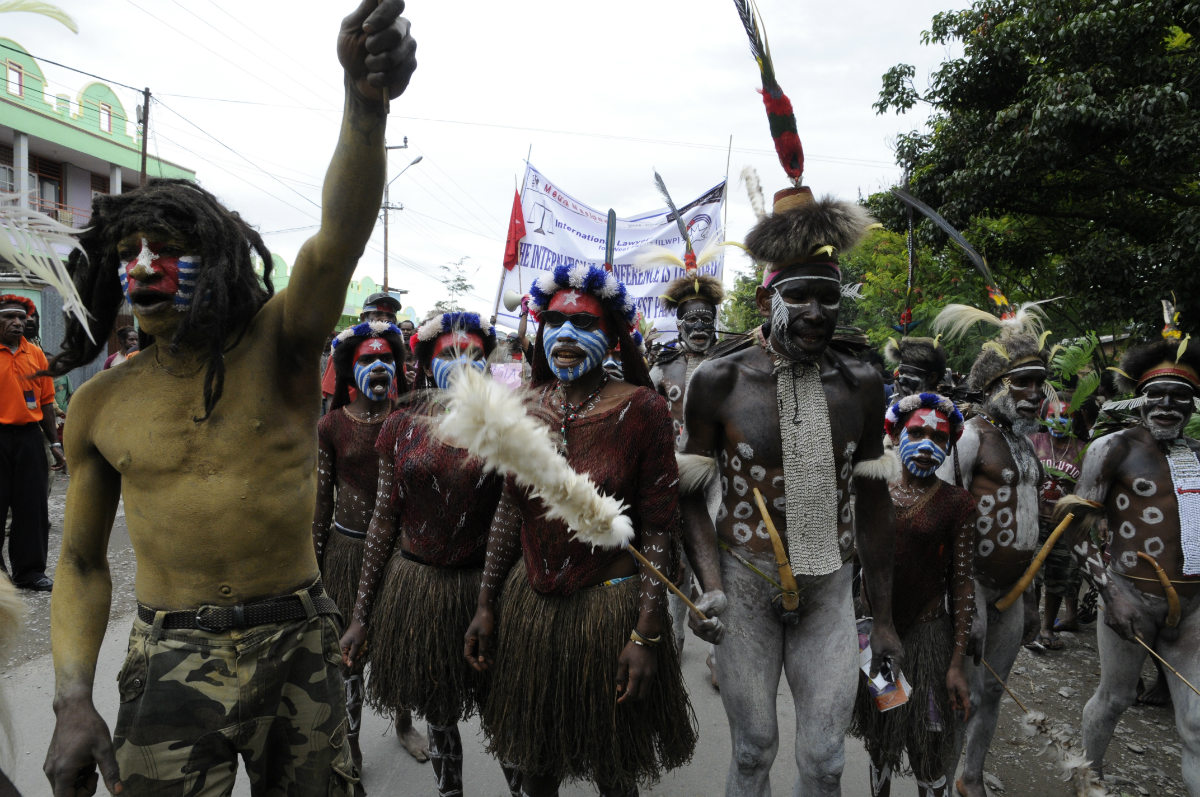
TV Papua, Vandaag in ons journaal en terugblik op 2 gebeurtenissen uit West Papua.

In Fak Fak was er een vreedzame demonstratie gehouden door de Papua's.
Ze riepen de Indonesische authoriteiten op, om alle politieke gevangen in West Papua vrij te laten.
Ook Het onrecht, ongelijkheid en discriminatie dat nu ruim 50 jaar structureel aanwezig is in West Papua moet stoppen.
De demonstranten droegen grote borden met foto's van onder andere Hilary Clinton, Parlementariers en andere politieke figuren.


West Papua wordt ruim 50 jaar gekoloniseerd door Indonesie en de realiteit in West Papua is verre van een Democratie.
De Papua's willen een VN interventie, aangezien het blijkt dat Jakarta totaal geen wil heeft om de Papua's perspectief te bieden. en
Op 26 juli jongsleden was er een openbare rechtszitting in West Papua, met Filip Karma en Buchtar Tabuni.
Tijdens de zitting werden ze door de Rechter uitgehoord en ondervraagt.
(Bron: http://www.youtube.com/watch?v=WwAhkP5j71M&feature=player_embedded)

Benny Giay: "Journalists in West Papua doing the same thing with Journalists in SouthAfrica during Apartheid Era"

Written By Voice Of Baptist Papua on July 27, 2012 | 12:29 AM

Benny Giay (photo jubi)
Jayapura Jubi, (26/7)---Benny Giay, Chairman of the Synod of Kingmi on West Papua said that news of Papua, published by local and national mass media (Indonesia) have occurred in South Africa in the apartheid era. Investors and the government should control the public mind in a discriminatory manner through journalists and mass media.

"I think the news in the history of the community/state totalitarian and repressive m edia owner are required to follow the will of the regime. They, the media managers or journalists who write the story from the perspective of a victimized by totalitarian and repressive regimes are considered as trouble." Benny Giay said totabloidjubi.com, Wednesday (27/6) in Jakarta via mobile phone.

In the same place, Septer Manufandu, Executive Secretary of Foker LSM Papua also saidthat the mass media and journalists have been instrumental in Papua to fertilize the stigma of separatist andalso helped construct the public opinion that the perpetrators of terror and violence these days is the Papuans.

"The news media and journalists are very discriminating. This is a problem for us Papuans, because news like this fosters separatist stigma and make people think that the perpetrators of current terror and violence are the Papuans.

Though police are not able to prove it." Septer said to reporters in Jakarta, Tuesday, June 26th.
According to Benny Giay, these circumstances indicate that the media managers or journalists in this context has a discriminatory act. However, he also understands if this situation can sometimes occur because of the ruling regime had a stake in the media in which journalists work.

"Noam Chomsky have a view about this culture in which the investor or the authoritiescontrolling the public mind with the one-sided message that discriminated against a group that was sacrificed. Journalists in West Papua doing the same thing with Journalists in South Africa during Apartheid Era in the 1950s or in Indonesia in the 19th century. Nothingnew in Papua. " Benny Giay said to confirms his view.

Press freedom in South Africa does have a fragmented history. Some sectors of the South African media can openly criticize the system of apartheid and the National Party government, but they are
hampered by government censorship for years. Besides, not many journalists in the apartheid era, which could draw a clear boundary between truth and the interests of the ruler. Also of particular interest from the media companies they work for. At the time of apartheid, the control of journalists and mass media is very powerful. Mass media are dominated by noise and information from the

One example is the death of Steve Biko, a South African student leader who founded the Black Consciousness Movement. On August 18, 1977, Biko was arrested by the police of Africa. Biko was
arrested on charges of violating South Africa Act, No. 38, 1967 on Terrorism. He was interrogated by police officers from Port Elizabeth, Harold Snyman and Gideon Nieuwou dt. Interrogation that lasted twenty-two hours, including torture and beatings that resulted Biko coma. 

He s uffered serious head injuries while in police custody and was chained to a window grille for a day. Mass Media in South African did not wrote this torture, but wrote Biko was arrested for violating the Terrorism Act, until a journalist and now political leader, Helen Zille, along with Donald Woods, who is also a journalist and an editor, reveal the truth behind Biko's death.

Steve Biko died shortly after arriving at the Pretoria prison, on 12 September 1977. The police claimed his death was the result of a hunger strike which he did. But an autopsy revealed bruises and abrasions that led to Biko give up on a brain hemorrhage from a large wound in his head. An autopsy was used as powerful evidence that Biko was brutally beaten by his captors.

The attitudes of mass media in South Africa during the apharteid era on Biko's death is almost equal to the attitude of local and national mass media in Indonesia againstthe death of Mako Tabuni, the Vice Chairman of the National Committee of West Papua (KNPB). 

Journalists and mass media only writing base on the view of the police without any express testimony of the witnesses. Mako Tabuni, reported by newspapers shot to death because he tried to fight back to the police, while some witnesses expressed Mako Tabuni was shot without warning. (Jubi/Victor Mambor)

Fear, Grief and Hope in Occupied West Papua

Written By Voice Of Baptist Papua on July 24, 2012 | 8:24 PM

The complex and volatile situation in West Papua raises questions about the role of international advocacy

Papuan Rally KNPB (photo martin)
The months of May and June have seen new waves of terror sweep through the troubled region of West Papua. Tens of “mysterious killings” have been reported, occurring mostly in the Papuan capital of Jayapura. Security guards, students, and soldiers have been shot dead; a woman’s mutilated body was found; and a German biologist narrowly survived being shot in the chest at a popular beach. With worldwide coverage of these incidents, the Indonesian security establishment has manipulated the climate of terror to justify more intense repression of Papuan nationalist groups. This campaign climaxed on June 14 with the assassination of Mako Tabuni, the vocal deputy chair of KNPB (West Papua National Committee) – an organization that has been at the forefront of mass mobilizations demanding a referendum on Papuan independence. While advocates in the West have recently seen more success in terms of putting Papuan human rights on the international community’s agenda, this international visibility has been matched in Papua by the proliferation of forms of state terror. This increasingly tense situation may demand a re-evaluation of the work of international solidarity advocates.

Here published: Intercontinentalcry.org/

(Not-so-)Mysterious Killings

The latest incidents in Jayapura have been shrouded in uncertainty and subject to wildly contrasting interpretations. Human rights activists in Jakarta and Jayapura, accustomed to seeing the hand of security forces behind such “mysterious” terror, have issued statements critical of Jakarta’s “security approach”, suggesting that the army and police are themselves responsible for the violence. While these critical views have informed international news coverage, Indonesian news coverage has tended to give more space to police statements evoking shadowy “unknown persons” and pinning the blame on the student activists of KNPB as well as the wider network of underground Papuan nationalist resistance, OPM (Free Papua Organization).

Politically speaking, it is hard to see what Papuan nationalists could gain from inflicting public terror. Human rights activists have pointed out the professional aspect of the shootings, suggesting sniper expertise only available to elite state units such as Kopassus (Army Special Forces Commando) or Densus 88 (the Australian- and US- funded Police counter-terrorism unit). As with the fatal shooting ambush on a bus outside Jayapura last August, which took place the day before a major KNPB mass rally (itself timed to welcome a conference on Papuan independence in the UK), the latest killings appear to have been staged by powerful elements in the security forces so as to disrupt grassroots pro-independence mobilizations.

The recent episode also recalls the massive campaign of “petrus” (contraction of penembakan misterius, “mysterious shooting”) against so-called “criminals” in Jakarta, used by Suharto’s New Order regime to entrench its power in the 1980s. The police attributing the label “criminal” to KNPB leaders such as Mako Tabuni feeds a perception that Indonesian governance in Papua continues to employ a version of the “politics of fear” that sustained the New Order for so long.

The new petrus campaign in Jayapura, and the assassination has set the stage for, and has unfolded alongside other forms of terror. Just a week before Mako Tabuni’s murder, an outbreak of brutality was triggered in the main highlands town of Wamena when two Indonesian soldiers on a motorcycle struck a Papuan child. After some local residents reacted angrily by stabbing the soldiers to death, the soldiers’ fellow troops from the notorious Infantry Battalion 756 “Wim Ane Sili” (local Dani language for “House of the Sound of War”) descended on the scene armed with bayonets and rifles, and unleashed a vengeful swath of destruction. 

The attacks left several locals dead or injured, an entire village razed to the ground, and hundreds of Papuan residents displaced to the bush.  Battalion troops then rampaged through Wamena town, burning regional government buildings and the homes of both indigenous Papuans and Indonesian settlers. In the aftermath of the violence, with many residents still in hiding, local human rights activists evoked the memory of the October 2000 incidents known as “Bloody Wamena” (Wamena Berdarah) – when deadly riots and a massive crackdown followed police attacks on posts flying the Morning Star flag of Papuan nationalism.[1]

In a Context of Fear, KNPB Mobilizes

Recent events in Wamena have reflected tensions in Jayapura. KNPB is known to have an especially strong support base among students from the highlands region around Wamena who have settled in the coastal metropolis of Jayapura. Highlanders are often subject to especially severe forms of the racism that most Papuans face in the Indonesian urban context. Though KNPB’s mass mobilizations have been largely peaceful, stereotypes of violent and chaotic highlanders have been used to build fear of their politics via conspiratorial text messages presumably circulated by intelligence agents – a form of rumour that many Papuans refer to as “terror” (teror).

In the face of fear and intimidation, KNPB has continued to mobilize, organizing mass protests to denounce the role of state security agents in creating the climate of terror. In a press release days before Mako Tabuni’s death, KNPB suggested that state agents had played a role in the shooting of the German scientist, as a response to Germany’s criticism of Indonesia’s human rights record in Papua at a recent UN session.[2] Security forces have responded to KNPB’s challenge with unrestrained aggression, deploying Barracuda mobile tanks and live fire against unarmed protesters, and arresting KNPB chair Buchtar Tabuni on his way out of a meeting at the provincial parliament convened by political leaders to discuss the deteriorating security situation. This is the volatile situation within which Indonesian forces (in this case, reports suggest it was Densus 88) have been able to eliminate a courageous and articulate voice of Papuan resistance.[3]

While Western governments periodically pay lip service to the importance of upholding human rights in Papua, one can guess at the deep (though surely unstable) complicities linking the interests of transnational capital, global governance institutions, and the military intelligence regime on Indonesia’s Pacific frontier zone. The brutal crackdown underway against KNPB targets a group that has articulated a sophisticated anti-imperialist critique of the neo-liberal development policies being forced on Papuans by the Indonesian security state, the global resource companies that help fund it (notably US mining giant Freeport MacMoran and British oil and gas giant BP), and the foreign governments and international institutions who occasionally criticize Indonesia’s human rights performance but who are hostile to Papuan challenges to the status quo of Indonesian sovereignty. This is the global context that enables multiplying forms of terror and allows for the assassination of Mako Tabuni.[4]

The latest wave of killings and repression has come at a moment when KNPB has been intensifying its regional outreach work, enacting a program for a “West Papuan Parliament” that would channel forms of direct democracy towards the goal of self-determination. The prospect of a politicized and mobilized anti-imperialist network spreading throughout the regions of Papua is surely viewed with suspicion by both the Jakarta intelligence establishment and the international players with interests in the region.

KNPB’s grassroots political mobilizations complement the higher-level manoeuvres of the leaders of groups such as WPNA (West Papua National Authority) and DAP (Papua Customary Council), who came together at last October’s Third Papuan Congress to declare the Federal Republic of West Papua (FRWP). As the Congress closed, police, army and intelligence units stormed the site, beating and arresting hundreds and killing several. The newly-proclaimed president and prime minister of FRWP, Forkorus Yaboisembut and Edison Waromi, remain behind bars along with Congress organizers and a growing list of political prisoners convicted of “subversion” (makar).[5]

What Kind of International Solidarity?

Given the complexity and volatility of the political situation, it is not clear what helpful role solidarity advocates can play. The Indonesian state and media do not hesitate to attribute signs of Papuan “separatist” agitation to the shadowy forces of a “foreign conspiracy” seen as responsible for East Timor’s independence. It is worth understanding Indonesian nationalist anxieties in their historical and geopolitical context: the Indonesian nation was founded when the then-revolutionary national army expelled Dutch colonialists from most of the archipelago after WWII; 15 years later, the military launched operations to chase the Dutch out of Western New Guinea as well (the Dutch finally retreated under US and UN pressure). At the time, the standard Indonesian nationalist narrative framed the incorporation of Papua as a question of opposing imperialism, and the West Papuan movement as colonial puppets.[6] 

 More recently, Western support for East Timorese independence – and signs of such support being extended to West Papua – have been easy to frame as vehicles for the West’s neo-imperial manipulation and pursuit of the region’s abundant mineral and petroleum resources. The more Western advocates succeed in focusing global attention on the plight of Papuans under Indonesian rule, the more the Indonesian security establishment can deploy the specter of a “foreign intervention” (like the UN’s intervention in East Timor) to mobilize Indonesian public opinion behind its harsh policing measures. The current moment poses a stark challenge to action-oriented observers: how to generate global solidarity against injustice in West Papua without strengthening the state’s pretext for terror?

Part of the answer may lie in the spaces for exchange that are being generated through networks like Intercontinental Cry: spaces where actors engaged in different worldwide struggles for justice can share perspectives (ideally) unmediated by giant corporations, intergovernmental institutions, INGO culture, or unreflexive settler-colonial privilege. To put in plainly: the international West Papua solidarity movement is in need of platforms for exchange that do not center the voices and perspectives of white people. Subject to numerous waves of colonization, displacement and militarization, West Papuans have political affinities with colonized, displaced, racially-deprived, and otherwise subjugated peoples at a global level. But the dynamics of history and geopolitics have produced a situation where mainly white NGO workers and human rights activists have largely monopolized international access to the scene of West Papuan resistance politics. 

Collaborations with leftists and rights activists in Indonesian cities have been key to the Papuan movement, as they were for East Timor; so have expressions of support by African-American and Pacific US legislators. Still, global Papua solidarity advocates have prioritized high-level lobbying towards Western powers, at the expense of possibilities for “South-South”/intra-“Fourth World” networking. For Indonesia’s deep security state to lose its “anti-imperialist” pretext for repression, solidarity linkages need to bypass neo-colonial adventurist-activist gatekeepers (including this author) – agents of what Teju Cole (referring to the “Stop Kony” debacle) has called the “White Saviour Industrial Complex”[7].

In the 1950s, when Dutch planners were forced to abandon their colonial project in Indonesia, they refocused their fantasies of “ethical” imperialism on the supposedly “blank slate” of Western New Guinea. These colonial agents framed Papuans as “primitives” requiring “development” before they could be allowed to govern themselves. The legacy of this history lives on in the Indonesian state’s colonization project, fed by media depictions of Papuans’ supposedly “backwards” life ways.[8] Throughout this history, Papuans have consistently been imagined as objects to be governed by others, rather than as political actors struggling for dignity.[9] Transnational human rights advocacy has succeeded in getting the story of Papuan suffering out there on the global stage; but the spectre of Western intervention is also justifying and motivating the terror it seeks to stop. Prevailing models of international advocacy may not be working for West Papua; they are easy for the security state to manipulate towards its own ends – which happen to suit other powerful global actors as well. Western-centric human rights champions need to consider making way for alternative paradigms of direct solidarity among colonized and displaced peoples.

Fear, Grief and Hope in Occupied West Papua was originally featured in People Land Truth, an eBook by Intercontinental Cry.

References

[1] See “Indonesia: Investigate military attacks on villagers in Wamena, Papua”, Amnesty International, June 8 2012, http://www.amnesty.org/en/library/asset/ASA21/020/2012/en/1b64dac4-87d7-46c8-8950-f838afa35d87/asa210202012en.html
[2] See “German born tourist shot by “unknown persons” whilst on a beach in Jayapura”, http://westpapuamedia.info/2012/05/31/german-born-tourist-shot-by-unknown-persons-whilst-on-a-beach-in-jayapura/
[4] See footage of a speech by Mako Tabuni at a KNPB mass rally in Jayapura, in which he condemns the entanglement of Indonesian state power with foreign capital (in Indonesian): http://www.engagemedia.org/Members/yerry/news/papua-mako-tabuni-funeral-2
[5] See, for example, “Forkorus: International community must acknowledge the rights of the people of West Papua”, Jubi Online, http://westpapuamedia.info/2012/02/16/forkorus-international-community-must-acknowledge-the-political-rights-of-the-people-of-west-papua/
[6] For analysis of clashing Papuan and Indonesian nationalist historical narratives, see David Webster, “Narratives of Colonization, Decolonization and Recolonization in Papua”, http://activehistory.ca/papers/history-paper-3/
[7] See Teju Cole, “The White Savior Industrial Complex”, The Atlantic, March 21 2012, http://www.theatlantic.com/international/archive/2012/03/the-white-savior-industrial-complex/254843/
[8] Scholar Danilyn Rutherford has documented this imperial legacy and its effects: see her new book “Laughing at Leviathan: Sovereignty and Audience in West Papua” (University of Chicago Press, 2012).
[9] Another new book shines light on this struggle, tracing West Papuan nationalists' approaches to the Indonesian state, international advocates, and global power centres: Eben Kirksey's "Freedom in Entangled Worlds: West Papua and the Architecture of Global Power" (Duke University Press, 2012).

20 Gereja di Aceh Disegel dan Terancam Dibongkar

Written By Voice Of Baptist Papua on June 13, 2012 | 12:58 AM


Sekalipun Sidang UPR 23 Mei 2012, Negara-Negara Anggota PBB Menanyakan Soal Intoleransi Beragama Namun Pemerintah Tetap saja melakukan pemalangan terhadap kaum minoritas di Indonesia

Eva Kusuma Sundari.
Jakarta,-- Sebanyak 20 gereja di Aceh, khususnya di Kabupaten Singkil, telah disegel dan terancam dibongkar oleh pemerintah daerah setempat. Gereja-gereja itu dianggap tidak memenuhi syarat pembangunan tempat ibadah yang ditetapkan pemerintah daerah.


Anggota Komisi III DPR dari Fraksi PDI Perjuangan, Eva K Sundari, mengatakan, ia dan politisi PDI-P lain, yakni Adang Ruchiatna dan Moh Sayed, serta Suroso dari Fraksi Partai Gerindra, menerima pengaduan penutupan 20 gereja di Aceh dari Aliansi Sumut Bersatu, Senin kemarin.

Sumber masalah dari penutupan tempat ibadah itu, kata Eva, yakni Peraturan Gubernur Nomor 25 Tahun 2007 tentang Pedoman Pendirian Rumah Ibadah. Dalam Peraturan itu, lanjut dia, syarat pendirian tempat ibadah lebih berat dibanding Surat Keputusan Bersama (SKB) dua menteri yang mengatur hal sama.


"Kalau SKB mensyaratkan 60 anggota jemaat gereja untuk mengajukan permohonan IMB (izin mendirikan bangunan), maka peraturan gubernur itu meminta 150 anggota jemaat," kata Eva di Gedung Kompleks Parlemen Senayan, Jakarta, Selasa (12/6/2012).

Eva menambahkan, yang lebih menyedihkan adalah adanya fatwa lokal yang mengharamkan umat Muslim untuk memberi tanda tangan persetujuan pembangunan tempat ibadah selain masjid. Artinya, kata dia, upaya meminta tanda tangan persetujuan dari masyarakat sekitar tidak mungkin tercapai.


Eva menambahkan, bukan hanya tempat ibadah baru yang terancam dibongkar. Gereja Kristen Protestan Pakpak Dairi yang sudah berdiri sejak 1932 pun dipaksa untuk mengikuti kesepakatan komunitas tahun 1971 dan 2001 yang berisi hanya memperbolehkan satu gereja di Kabupaten Singkil.
"Sesuatu yang tidak relevan mengingat saat ini penganut agama Kristen sudah mencapai 1.500 keluarga. Mereka menyebar di seluruh wilayah Kabupaten Singkil. Belum lagi umat Khatolik yang tidak mungkin berbagi gereja dengan umat Protestan," ucap Eva.

Eva mengatakan, perlu ketegasan dan bimbingan dari pemerintah pusat agar pelaksanaan keistimewaan Aceh tetap dalam koridor NKRI. Menurut dia, kesepakatan tahun 1971 dan 2001 itu tidak sesuai dengan konstitusi sehingga tidak boleh dipaksakan.

"Bimbingan dari Menteri Dalam Negeri (Gamawan Fauzi) diperlukan agar muspida dan Kapolres dapat bertindak adil dan netral bagi semua warga negara sesuai hukum nasional dan tidak tertekan oleh ormas intoleran setempat," minta Eva.

KNPB Tuntut Segerah Bebaskan Buchtar, Cs

Written By Voice Of Baptist Papua on June 7, 2012 | 9:53 PM

Penangkapan Ketua KNPB dan Ketua Parlemen Nasional West Papua, Buchtar Tabuni bersama 2 rekan kami Riber Weya dan Hengky Alua  merupakan skenario Indonesia melalui Polda Papua untuk mengalihkan isu pelanggaran HAM yang dilakukan oleh TNI/Polri serta upaya menutupi ketidakmampuan kepolisian mengungkap pelaku-pelaku penembakan di West Papua, dengan modus mengkambinghitamkan gerakan perlawanan damai yang dilakukan KNPB.

Lihat saja, berbagai kasus penembakan di Puncak Jaya, Timika, Paniai, Wamena serta beberapa daerah dalam beberapa waktu terkahir terbukti bahwa Polisi Indonesia tidak mampu mengungkap pelaku, apalagi menangkap dan menghukum pelaku yang jelas-jelas terbukti.

Beberapa kasus penembakan OTK di Timika, sampai hari ini Polisi belum mengungkapnya. Berikutnya, penembakan 5 warga sipil di Degeuwo Paniai yang jelas-jelas dilakukan Brimob Polda Papua belum juga ditangkap dan diadili. Penembakan Terijoli Weah (2/5) saat demo damai KNPB, walaupun ditemukan serpihan peluru, Polisi tidak mampu mengungkap. 

Penembakan terhadap warga Jerman, Dietmar Pieper di Base-G pun belum sanggup diungkap Polisi melalui Tim yang dipimpin Wakapolda Papua, Paulus Waterpau.
Dan, baru pagi hari kemarin (7/7) Teyu Tabuni dibunuh tanpa alasan oleh anggota Polres Jayapura di Yapis, Polisi tidak menangkap pelaku. Buchtar Tabuni yang hendak bertanggung jawab dan mengklarifikasi tuduhan terhadap KNPB di depan DPRP, Kapolda, Pangdam dan Tokoh-Tokoh Masyarak kemarin (7/7) justru ditangkap tanpa prosedur penangkapan resmi (tanpa surat pemanggilan).

Padahal, aksi KNPB pada 4 Juni lalu adalah aksi damai menuntut polisi mengungkap pelaku penembakan yang terus terjadi di Papua. Dan KNPB telah melayangkan surat pemberitahuan aksi ke Kapolda dan Direskrim Polda Papua. Lantas, mengapa aksi damai rakyat Papua diblokade polisi yang menggunakan senjata lengkap? Mengapa tidak membiarkan KNPB melakukan aksi damai seperti biasanya?

KNPB sangat memahami prinsip-prinsip kemanusiaan, perdamaian dan demokrasi secara universal. Oleh sebabnya, ribuan massa rakyat Papua Barat selama ini dikoordinir secara damai untuk menyampaikan tuntutan rakyat secara terbuka. KNPB memahami bahwa, anarkis dan kekerasan tidak mengungtungkan dan justru merugikan dalam perjuangan KNPB. Oleh karenanya, KNPB tidak sama sekali menghasut dan mengatur kekerasan terjadi dalam perjuangan yang damai ini.

Kami sangat memahami bahwa Indonesia dengan kepentingan kolonialisme dan kapitalisme global diatas tanah ini tidak akan menjujung tinggi nilai-nilai kemanusiaan dan keadilan. Karena itu, penguasa dengan berbagai macam alasan, bersama kekuatan media-media propaganda penguasa akan terus mendiskreditkan, menstigma dan membunuh gerakan perlawanan damai yang dilakukan oleh KNPB diatas tanah surga ini.

Demi rakyat kami, diatas tanah kami, dan demi keadilan, kemanusiaan dan perdamaian dunia, KNPB akan tetap berjuang mewugjudkan cita-cita bangsa West Papua, yaitu merdeka sebagai sebuah bangsa yang bebas dari kungkungan kolonialisme Indonesia, kapitalisme global dan militerisme Indonesia.

Kami menuntut:
  1. Bebaskan Buchtar Tabuni,cs dan usut pelaku pelanggar HAM di Papua
  2. Solidaritas Internasional dalam penyelesaian masalah Papua Barat
  3. Selesaikan persoalan Papua melalui referendum yang damai, demokratis dan final.
Tujuan Indonesia di West Papua cuma satu: Membunuh orang Papua dan menguasai tanah Papua. Siapapun, baik secara pribadi, kelompok maupun negara-negara yang mendukung perlakukan Indonesia di Papua Barat, dia juga merupakan pelaku kejahatan di West Papua.
“Kita Harus Mengakhiri”

 Realese From Secretariat office
West Papua National Committe ( KNPB)

Struktural diskriminasi terhadap orang Papua Terjadi banyak kabupaten di Papua

Written By Voice Of Baptist Papua on March 28, 2012 | 11:15 PM

Papuan (foto Ilustrasi)
Sebuah laporan sangat mengungkapkan tentang bagaimana masyarakat adat Papua sedang menolak akses ke sesuatu yang mendasar seperti pendidikan, dengan demikian mempertahankan posisi mereka sebagai Tertindas (tapol)

Penulis buku, Paradoks Papua, The Paradox Papua. mengatakan bahwa ada diskriminasi sistematis terhadap rakyat asli Papua di Keerom di semua bidang usaha.

Cipry Jehan, penulis, berbicara pada seminar tentang Hanya Pembangunan yang diselenggarakan oleh Gereja Katolik di Keuskupan Keerom.

"Ada ketidakadilan sosial struktural di Kabupaten Keerom dan disusun sekitar rakyat marga dan agama. '

Ia mengatakan bahwa diskriminasi ini terlihat dalam semua aspek kehidupan dan karena pemerintah memusatkan semua pengembangan kegiatan di distrik Arso dan Skamto.

Twitt VBPapua

 
Support : Creating Website | Johny Template | Mas Template
Copyright © 2011. SBP-News @VBaptistPapua - All Rights Reserved
Template Created by Creating Website Published by Mas Template
Proudly powered by Blogger