German biologist Pieter Helmut and his wife were walking up the beach
after swimming near the Papua provincial capital of Jayapura when a
bearded gunman suddenly got out of a van and opened fire.
Helmut,
54, had emergency surgery for life-threatening bullet wounds to the
stomach and thigh. He was lucky to survive the May 29 attack, unusual
even by Papuan standards.
He was among the victims of a spate of
random shootings in and around Jayapura in May and June which left six
people dead, including a 16-year-old student.
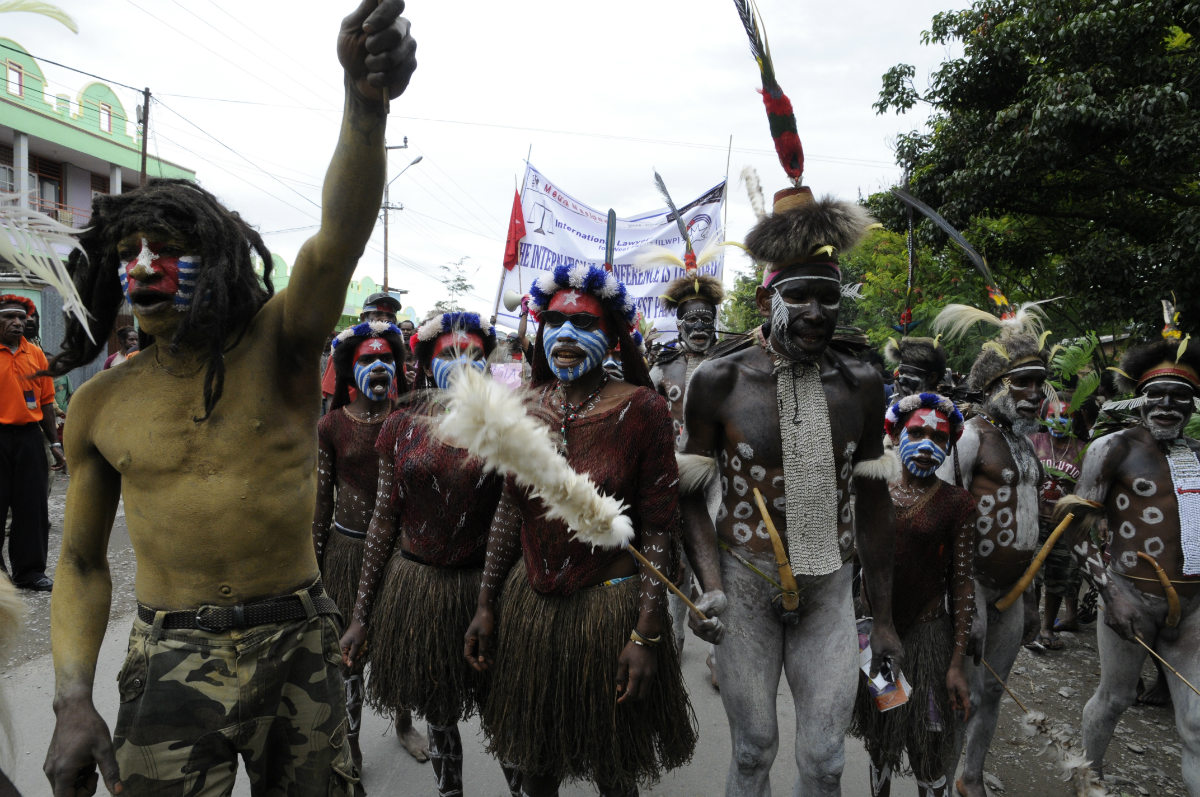
Indonesia's Papua province was once again in the headlines and back on the Cabinet agenda.
With
government hardliners in the ascendency, there is now every sign that
youthful Papuan militants, only loosely affiliated to the separatist
Free Papua Movement (OPM), have lost patience with the dialogue process
and are taking the fight to urban areas.
"Everything suggests
that there is going to be more trouble in Papua unless the government
can produce a policy that will have an immediate and visible impact on
how ordinary Papuans are treated," the International Crisis Group warned
in a recent report. It said the recent violence has exposed the lack of
a coherent government strategy to address the many dimensions of
conflict in Papua, with well-meant programs falling victim to security
imperatives or rent-seeking by police or soldiers in resource-rich
areas.
President Susilo Bambang Yudhoyono seems to be playing
both sides, telling Papuan leaders in private that he supports talks to
resolve Papua's many problems, and then saying publicly that there is no
need for talks at all, as he did in a major July speech.
At the
same time, the Unit for the Accelerated Development of Papua and West
Papua (UP4B), which was widely seen as laying the groundwork for a
prospective dialogue when it was created last November, has now been
told to stay away from politics.
UP4B head Bambang Darmono, a
retired two-star general who played a crucial role in the 2005 Aceh
peace process, told foreign journalists recently that his job was simply
to "coordinate and facilitate" government development programs.
Papua's
political leaders consider the territory's 2001 Special Autonomy Law to
be a failure, not necessarily because it doesn't hit the right notes,
but because it was hurriedly enacted without consultation with the
Papuans.
Likewise the UP4B. Despite the need for vastly improved
governance and an end to endemic corruption, the unit and other central
government interventions are regarded as efforts by Jakarta to
decentralize.
While Darmono agrees that the security situation
"doesn't look comfortable," he and other senior officials fail to see
the irony in their criticism of international news reports when foreign
reporters are banned from Papua and have to rely on often biased
accounts from both sides.
The sharp increase in bloodshed has not
been confined to Jayapura. At least 16 civilians, including a village
headman, and eight soldiers and policemen, have been killed across Papua
and neighboring West Papua province over the past three months.
Two
weeks after Helmut was wounded, patrolmen shot dead wanted activist
Mako Tabuni, a member of the supposedly non-violent West Papua National
Committee (KNPB), set up four years ago to campaign for a referendum on
Papuan independence.
The KNPB was at the center of a row in early
2010 when Western and Papuan rights groups challenged an International
Crisis Group report asserting that the committee was part of a growing
"radicalization" of the Papua resistance movement.
Whether
"radical" is the appropriate word or not, police claim to have telephone
intercepts and forensic evidence showing that Mako, KNPB leader Buchtar
Tabuni, Maluk Tabuni and three other suspects were responsible for the
Jayapura shooting spree.
Police insist Mako was killed while
trying to escape, but such is the level of mutual distrust, they will
have a hard job convincing anyone of that. There have been far too many
other cases with a similar disregard for Papuan lives.
Tabuni is a
common name, but Mako and Buchtar were cousins and the KNPB is believed
to have links to Goliat Tabuni, leader of one of the OPM's most active
guerilla groups in the mountainous Puncak Raya region far to the west.
The
violence is taking place in a political vacuum, with the Supreme Court
hearing Papua governor Barnabas Suebu's claim that he is entitled to a
third term and the Constitutional Court soon to rule on whether only
indigenous Papuans can run for public office.
The government
supports the view that candidates must be Melanesians. But for all of
Papua's special autonomy status, that would set a troubling precedent,
and ignores the fact that non-indigenous people now comprise half of
Papua's population.
Some officials believe separatists are using
the long delay in holding local elections to fuel communal tensions and
create the impression of rising instability in a troubled territory.
President
Yudhoyono bizarrely sought to play down the level of violence to
journalists in early June, saying the prolonged low-intensity conflict
could not compare with Afghanistan and Syria.
Complaining about
what he called "cause and effect," he referred to a June 6 incident in
the highland town of Wamena. Rioting soldiers killed one man and wounded
15 others after a soldier was stabbed to death for running his
motorcycle over a boy
.
Yudhoyono said the OPM wants to provoke an
over-reaction to attract global attention, a frank admission that
security forces still lacked the discipline and training required in a
such a highly charged environment.
Reprinted courtesy of The Straits Times (jakarta-globe)